

MACHINE VISIONFROM READING DATAMATRIX CODES TO 3D ANALYSIS OF OBJECTSWe provide comprehensive turnkey machine vision deliveries:
- design of the optimal display method
- design of a specific hardware solution
- creating custom software
- deployment and integration into existing technology, including training
- service
We provide comprehensive turnkey machine vision deliveries:
- design of the optimal display method
- design of a specific hardware solution
- creating custom software
- deployment and integration into existing technology, including training
- service
BASIC PRINCIPLE OF MACHINE VISION SYSTEMS
Cameras capture the image of an examined object and evaluate it according to the prescribed algorithm. Based on the result of the evaluation, the control system performs an action, most often it is the marking or elimination of a defective piece.
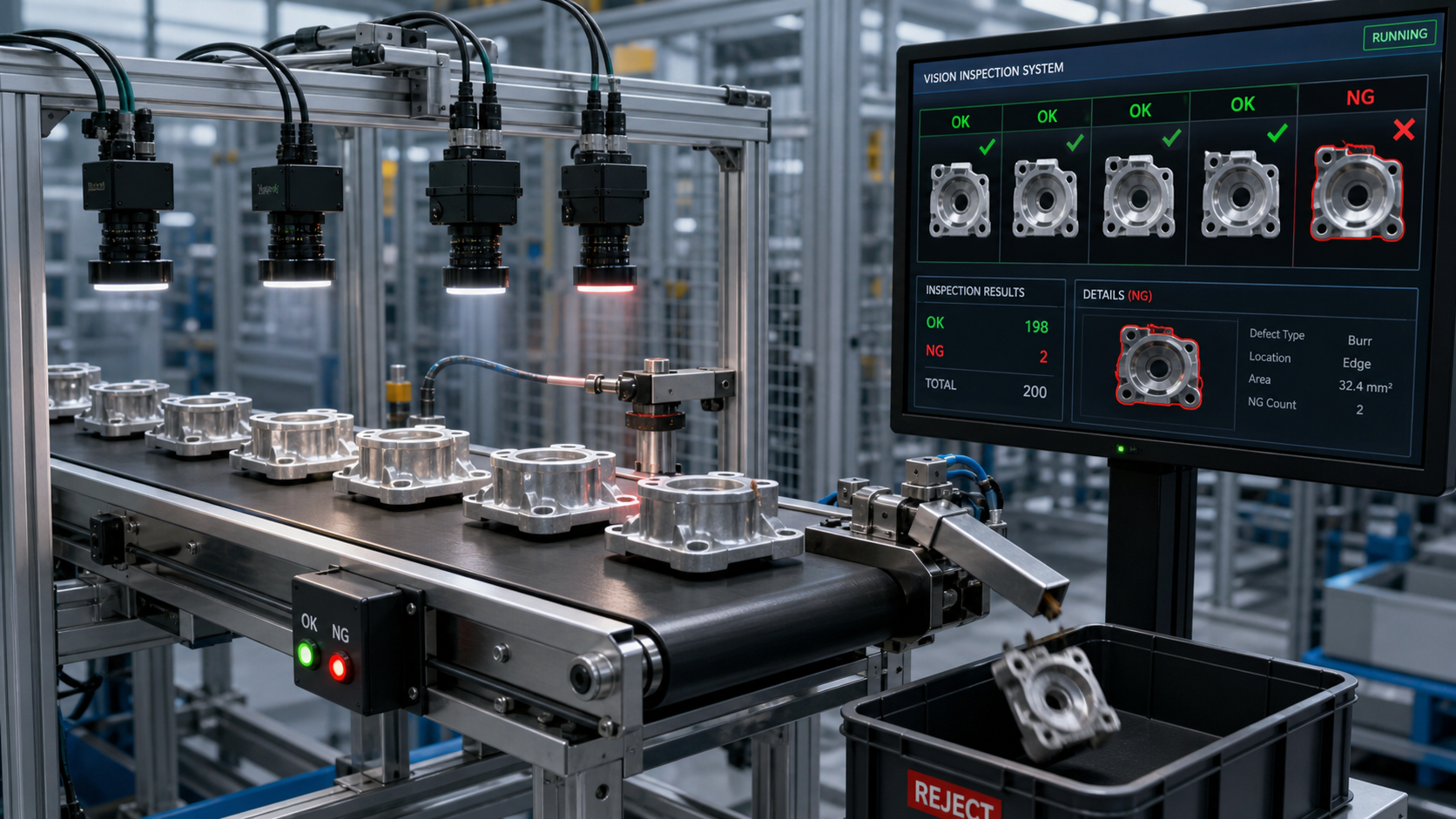

What are the benefits of machine vision?
The advantages of machine vision applications are in the objectification of measurements, independent of the human factor, in speed and accuracy, as well as in the possibility of incorporating measuring equipment into the production line and thereby directly and automatically influencing production parameters.
OPTICAL METHODS OF MEASUREMENT AND SUBSEQUENT PROCESSING OF DIGITALIZED IMAGE
enable the industry to solve most of the problems associated with measurement:
- SHAPES
- DIMENSIONS
- COLOURS
- PRINTS
- LOCATION
- NUMBER OF IDENTIFICATIONS
- SURFACE QUALITY
- THEIR DEFECTS AND DEVIATIONS
.. and other problems associated with general quality control in production.

WE ARE A CERTIFIED INTEGRATOR of machine vision manufacturer - cognex



WE DEPLOY machine vision systems from MVTec


INSPECTION OF INSERTED PARTS
The cameras located above the loading nests make it possible to check the presence of all the parts necessary for the subsequent process, and they also allow us to check the parts‘ positions and thus prevent possible collisions.
READING CODES AND RECOGNIZING ALPHANUMERIC CHARACTERISTICS
In addition to reading standard 1D and 2D codes, machine vision can be used to "read" so-called bit coding, and to read alphanumeric characters (so-called OCR) on product bodies.
The advantage of using machine vision is that it provides the opportunity to combine the above tasks and to expand them further.
CONNECTOR CONTROL
Machine vision has a wide area of applications in the field of connector production.
Camera systems are used for the control of individual components entering production, the control of inter-production operations and, last but not least, for the control of a completely assembled product. Flows, seals, insulation, crimps, paints, pin positions and much more are commonly controlled
COMPONENT INSPECTION
Camera systems enable non-contact fast measurement of product dimensions.
Using appropriate optics and calibration procedures, optical systems can provide results in absolute values.
INSPECTION OF PAINTS, ADHESIVES AND PASTE
Machine vision is used to check the presence and position of paint, glue and paste on products.
Very often, these substances contain fluorescent particles which, when illuminated by UV light, are visible in the visible area and which can then be safely detected.
GUIDANCE OF PRODUCTION TOOLS - BONDING
It is often necessary to specify the positions of semi-finished products in order to further process them.
One example is the position of the wire, which must be mounted in the correct position.
By calibrating the camera and the bonding tool located on the servo axes (or on the robot arm), the desired results can be achieved.
An additional bonus is the ability to control the "design" of the final bond
3D SCANNERS FOR ACCURATE MEASUREMENT
3D scanners are among the most accurate devices in the field of machine vision.
They are autonomous and calibrated systems that allow measurements in real units in the order of microns.
MACHINE VISION TOOLS
TOOLS FOR LOCATION OF COMPONENTS
TOOLS FOR LOCATION OF COMPONENTS
- Locating components and assemblies for inspection
- Identification of component placement for robotic manipulation, tolerance of changes in rotation, scaling and lighting differences
MEASURING INSTRUMENTS
MEASURING INSTRUMENTS
- Measurement and verification of tolerances of components, assembly kits and product labels
- Measurement of critical tolerance of medical and surgical equipment
FLAW DETECTION
FLAW DETECTION
- Inspection of contours and surface areas of parts
- This technology is able to adapt to variations in lighting and appearance of parts
FLEXIBLE DEFECT DETECTION
FLEXIBLE DEFECT DETECTION
- Finding defective edges, borders and surfaces
- Finding surface defects - such as stains or scratches
EDGE INSPECTION TOOLS
EDGE INSPECTION TOOLS
- Verification of correct assembly of components and finding defects in their appearance
- Finding deviations in the position of edges, defects and cracks
- Finding width weld beads along weld sections in weld joint tracking applications
OCR / OCV TOOLS
OCR / OCV TOOLS
- Read or verify data / batch codes from storage units (SKUs)
- Verify that the characters are readable and that the printer is working properly
FILTERING IMAGES
FILTERING IMAGES
- Highlight characteristics or remove characteristics from parts before further processing by other computer vision tools
ROBOT GUIDANCE TOOLS
ROBOT GUIDANCE TOOLS
- High speed and accuracy in pick-and-place applications
- Placing or removing parts or searching for loose parts on the conveyor belt and storing them in packaging
- Use robots to manipulate components or cameras to control critical component properties
COLOUR RECOGNITION TOOLS
COLOUR RECOGNITION TOOLS
- Identification, inspection, sorting and verification of products based on colour
- Comparing products based on colour
- Label identification to ensure proper product labelling
INSPECTION TOOLS
INSPECTION TOOLS
- Verify proper assembly of components and check component properties
- Verification of the contents and sealing of packaged goods
HISTOGRAM
HISTOGRAM
- Check or monitor component characteristics based on brightness
CODE READING TOOLS
CODE READING TOOLS
- Reading 2D codes for direct marking of objects (DPM)
- Reading and monitoring 1D and 2D codes and verifying print quality according to industry standards
BLOB
BLOB
- Detection of characteristics that have similar shades of gray
- Blob is very useful for quantifying defect sizes or for finding characteristics that do not have a repetitive shape
- Used on black and white and colour images to quantify the amount of a particular colour present
CALIBRATION
CALIBRATION
- High-precision robotic "grip and save" application for standard mounting and offset mounting due to cramped space conditions or limited robot movement
- Very precise dimensions of critical component dimensions
